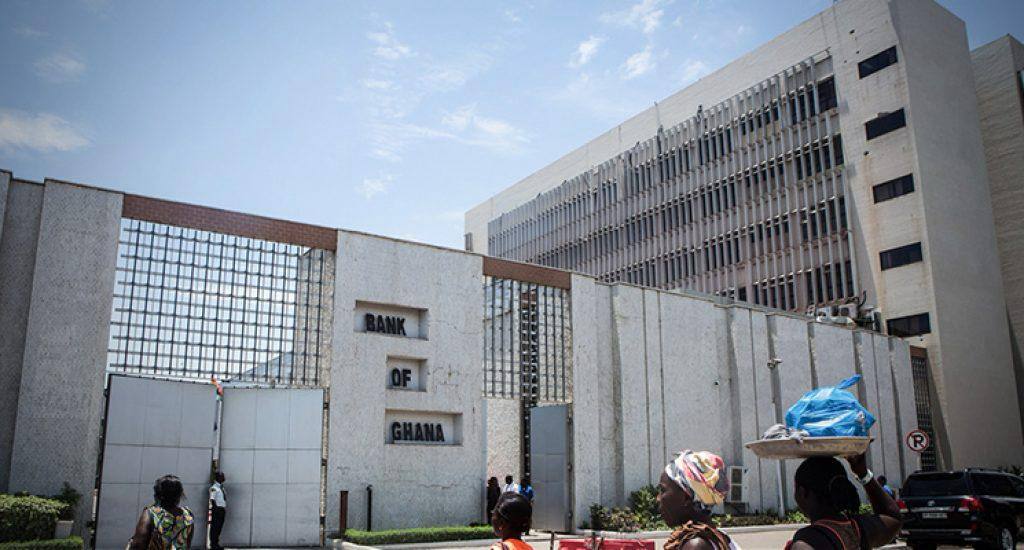





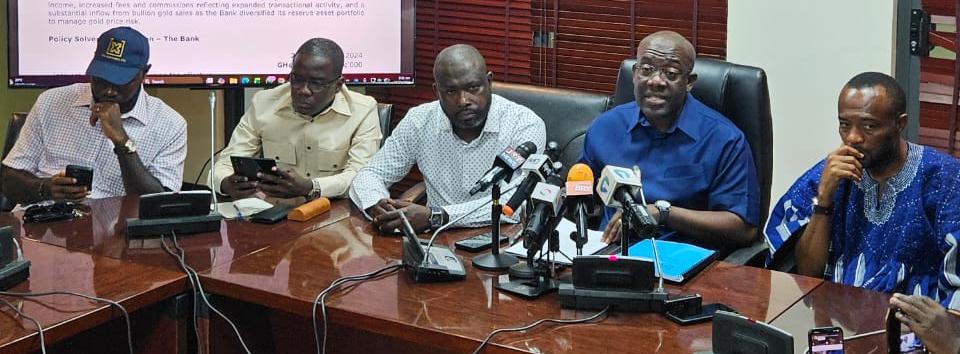
The Minority Caucus in Parliament has declared that the Bank of Ghana is now “policy insolvent,” citing what it describes as alarming revelations contained in the central bank’s 2025 audited financial statements.
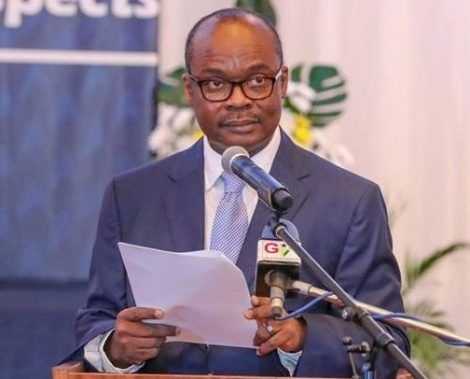
Addressing a press conference in Parliament, the Ranking Member on the Economy and Development Committee, Kojo Oppong Nkrumah, said a detailed review of the Bank’s 136-page report confirms long-standing concerns about the sustainability of its monetary operations.
“We have examined the accounts line by line, page by page,” he stated, adding that the Minority’s objective was not to gloat but to present the “true picture” of the Bank’s financial health and expose what it believes are inconsistencies in the government’s narrative.
Controversy Over Pre-Release Briefing
The Minority’s intervention follows an earlier press conference by the Majority, led by Atta Issah, which sought to justify the Bank’s losses as the cost of stabilising the economy.
However, the Minority criticised the move as a breach of due process, arguing that under the Bank of Ghana Act, audited accounts must first be submitted to the Finance Minister and then laid before Parliament—not presented through political briefings.
“The Bank of Ghana is not a political party, and its accounts cannot be reduced to a party press release,” Mr. Oppong Nkrumah said, warning that such actions risk undermining the Bank’s independence and credibility.
How the Minority Defines ‘Policy Insolvency’
Central to the Minority’s argument is the concept of policy solvency, which measures whether the Bank can fund its monetary policy operations—particularly liquidity management—using internally generated income.
According to the Minority, while the Bank reported operational income of GH¢22.2 billion and open market operation (OMO) costs of GH¢16.7 billion, creating an apparent surplus of GH¢5.5 billion, this figure is misleading.
They argue that the income figure includes a one-off gain of about GH¢9.6 billion from gold sales, which should not be treated as recurring operational income.
“If you remove the gold sale proceeds, the Bank’s operational income drops to about GH¢12.7 billion,” Mr. Oppong Nkrumah explained. “Subtract the OMO cost of GH¢16.7 billion, and you are left with a deficit of roughly GH¢4 billion.”
According to the Minority, this deficit means the Bank cannot sustainably finance its core policy functions, placing it in a position of policy insolvency.
“A central bank that must sell strategic assets to fund its operations is not solvent—it is operating on borrowed time,” he warned.
Disputing The ‘GH¢15.6bn Loss’ Narrative
The Minority also challenged the widely reported GH¢15.6 billion loss, insisting that the true financial impact is significantly higher.
They pointed to an additional GH¢19.3 billion recorded under Other Comprehensive Income (OCI), bringing the total loss to approximately GH¢34.9 billion. When adjusted for the gold sale proceeds, they estimate the underlying loss could reach GH¢44 billion.
“This is the loss that has been hidden from the Ghanaian people,” the Minority said, accusing the government of using accounting treatments to downplay the scale of the problem.
Accounting Framework Raises Concerns
Further concerns were raised about the accounting standards used in preparing the financial statements.
The Minority noted that the accounts were prepared under the Bank’s internal accounting policies rather than full International Financial Reporting Standards (IFRS), a point flagged by auditors and acknowledged by the Bank’s directors.
This approach, they argued, allowed significant losses—particularly exchange rate-related valuation losses—to be recorded in OCI instead of the main income statement, thereby reducing the headline loss figure.
Reversal of Recovery Trend
The Minority also highlighted what it described as a reversal of progress made in previous years.
2023 loss: GH¢13.23 billion
2024 loss: GH¢9.49 billion
2025 loss: GH¢15.63 billion
According to them, the Bank had been on a recovery path in 2024, with narrowing losses and improving equity. However, that trend has been reversed in 2025, with losses increasing and the Bank’s negative equity position worsening to about GH¢93.8 billion.
“The central bank was healing. Now it is deteriorating,” Mr. Oppong Nkrumah said.
Policy Decisions Blamed For Rising Costs
The Minority attributed the deterioration to key policy reversals, including: the removal of a dynamic cash reserve system that previously managed liquidity at lower cost
Changes to foreign currency reserve requirements for banks
Adjustments to the gold purchase programme, which they say shifted costs onto the Bank.
These decisions, they argue, led to a sharp increase in sterilisation costs, with the Bank paying over GH¢14 billion in interest to commercial banks holding its instruments.
Impact On Economy And Households
Beyond the financial figures, the Minority argued that the current policy approach has not translated into improved living conditions for Ghanaians.
They cited tight liquidity, limited access to credit for businesses, high cost of living, and rising youth unemployment as evidence that macroeconomic stability has not yet delivered tangible benefits.
“Stability of numbers is not the same as stability of livelihoods,” the Minority stressed.
Call For Urgent Reforms
Despite the sharp criticism, the Minority said its objective is to prompt corrective action rather than score political points.
“There is no triumph in being right when your country is bleeding,” Mr. Oppong Nkrumah said, announcing that the Caucus will soon present policy alternatives aimed at restoring the Bank’s financial stability.
The declaration that the Bank of Ghana is “policy insolvent” marks one of the strongest statements yet from the Minority, setting the stage for an intensified national debate over the central bank’s role, independence, and the long-term sustainability of the economic policies.