





Certification corroborates externally audited information-assurance controls, continuity planning and risk governance for Ghana’s trade and revenue backbone
KUMASI — Ghana Link Network Services Ltd has announced that its Kumasi Tier IV data centre, which accommodates and undergirds operations of the Integrated Customs Management System (ICUMS), has attained ISO/IEC 27001:2022 accreditation — a globally ratified benchmark for information-assurance governance.

The accreditation, conferred by CertiTrust following an independent external audit, ratifies Ghana Link’s Information Security Management System (ISMS) and corroborates the organisation’s methodical approach to preserving data confidentiality, integrity and availability across mission‑critical processes.
Company executives say the award materially augments stakeholder confidence throughout the national trade ecosystem, including the Customs Division of the Ghana Revenue Authority, clearing agents, importers and exporters, shipping lines, airlines, transport operators and other government ministries and agencies that depend on ICUMS for daily trade facilitation and revenue administration.
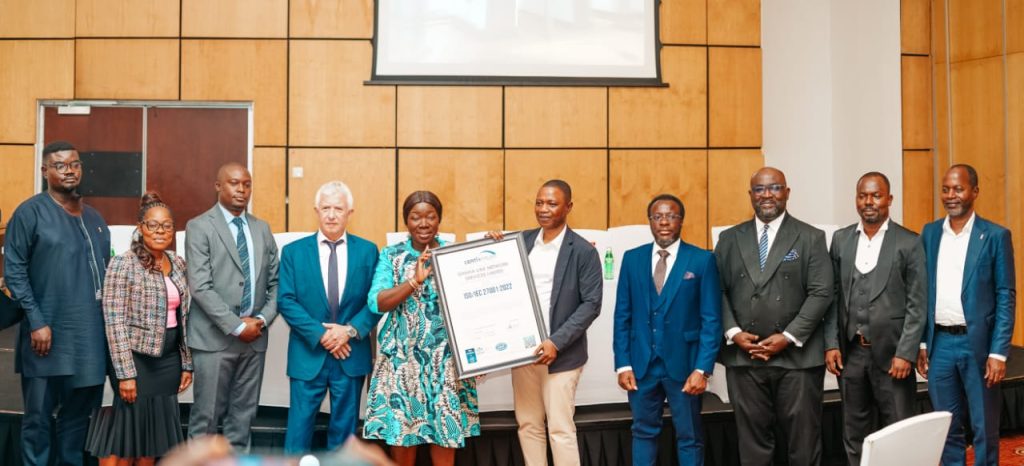
“This is not just a certificate moment, it is a trust moment,” Mrs Cynthia Addy said on behalf of the Managing Director of Ghana Link Network Services Ltd. “In our environment, performance cannot depend on effort alone. It must be built on standards, clear controls, repeatable processes, strong governance and measurable accountability. ISO/IEC 27001 confirms that we do not just talk about security; we live it, we audit it, and we improve it continuously.”
Providing technical exposition of the milestone, Dr Alvin Kwabena Ansah, Chief Technology Officer of Ghana Link, said the Kumasi facility was engineered for maximal availability, fault tolerance and operational continuity, eliminating single points of failure to ensure resilience for Ghana’s digital trade infrastructure.

“Our facility was designed for fault tolerance and business continuity, ensuring operational stability for Ghana’s digital trade ecosystem,” Dr Ansah explained. “We executed a seamless migration of critical systems with near‑zero downtime. But infrastructure alone was not sufficient. Through ISO/IEC 27001, we institutionalised structured risk management, reinforced access governance, integrated business‑continuity planning, and subjected ourselves to rigorous external audits.”
Dr Ansah emphasised that accreditation represents an enduring obligation rather than a terminus. “Certification is not a destination for us. It is a standard we now commit to maintaining. Ghana’s digital backbone is resilient, secure and globally benchmarked.”

Mr Erick Odea, Lead Auditor at CertiTrust, noted that the ISO/IEC 27001:2022 pathway demands demonstrable leadership commitment, consistent controls and an embedded security culture — not mere documentation.
“The journey toward compliance with ISO/IEC 27001:2022 is not a simple administrative exercise or a checkbox activity,” Mr Odea said. “It requires strategic direction from top management, structured risk assessment, documented controls, staff awareness and operational consistency. I’m pleased to state that the audit demonstrated Ghana Link’s Information Security Management System is effectively established, implemented, maintained and aligned with the standard.” He cautioned that the true dividend of accreditation is sustained discipline: “The true value of ISO 27001 lies not in the certificate displayed on the wall, but in daily risk‑based thinking, secure operational practices, staff awareness, and ongoing monitoring and improvement.”

Ghana Link acknowledged the contributions of technical collaborators and commercial partners, including Dell Technologies and Get4Less, alongside its internal engineering and operations teams, which supported audit preparedness, control implementation and the systems migration that accompanied the facility’s commissioning.
The company said the accreditation reinforces the government’s broader trade‑facilitation agenda by buttressing system dependability, restoring confidence in customs processes and enhancing Ghana’s attractiveness to trade‑linked investment and supply‑chain participants.